
Industry's take on AI in video games: Impact on jobs, rise of smaller studios, and future of gaming
Here's what game developers think about AI's prevalence in industry, and a brief look at Nvidia's push into the future.








Artificial Intelligence has been the buzzword since 2022, when ChatGPT was revealed to the public.
This was a major turning point
for the digital world.
Investment in AI has skyrocketed, with millions being poured by big tech companies such as Nvidia, Google, and Microsoft in search of rapid growth.
Within three years, AI has already entered the professional space and has begun influencing content creation, marketing, finance, and other fields.
The video game industry is no exception.
Here’s how game developers feel about it.
Thomas Wood
Senior Game Developer at Scriptic


“People are seeing it as a silver bullet rather than a powerful tool.”
Thomas Wood believes AI can positively impact video game development. He works at Scriptic, a BAFTA-nominated gaming studio currently working on providing user-generated games using Generative AI.
“I think game development has become too expensive, especially on the AAA [term for games published by major studios] side, and any tooling that can help speed up production and reduce costs is good, as long as it’s a tool and not replacing people."
AI has been a useful tool for Mr Wood for coding support, learning new technology, refactoring old code, and writing tests.

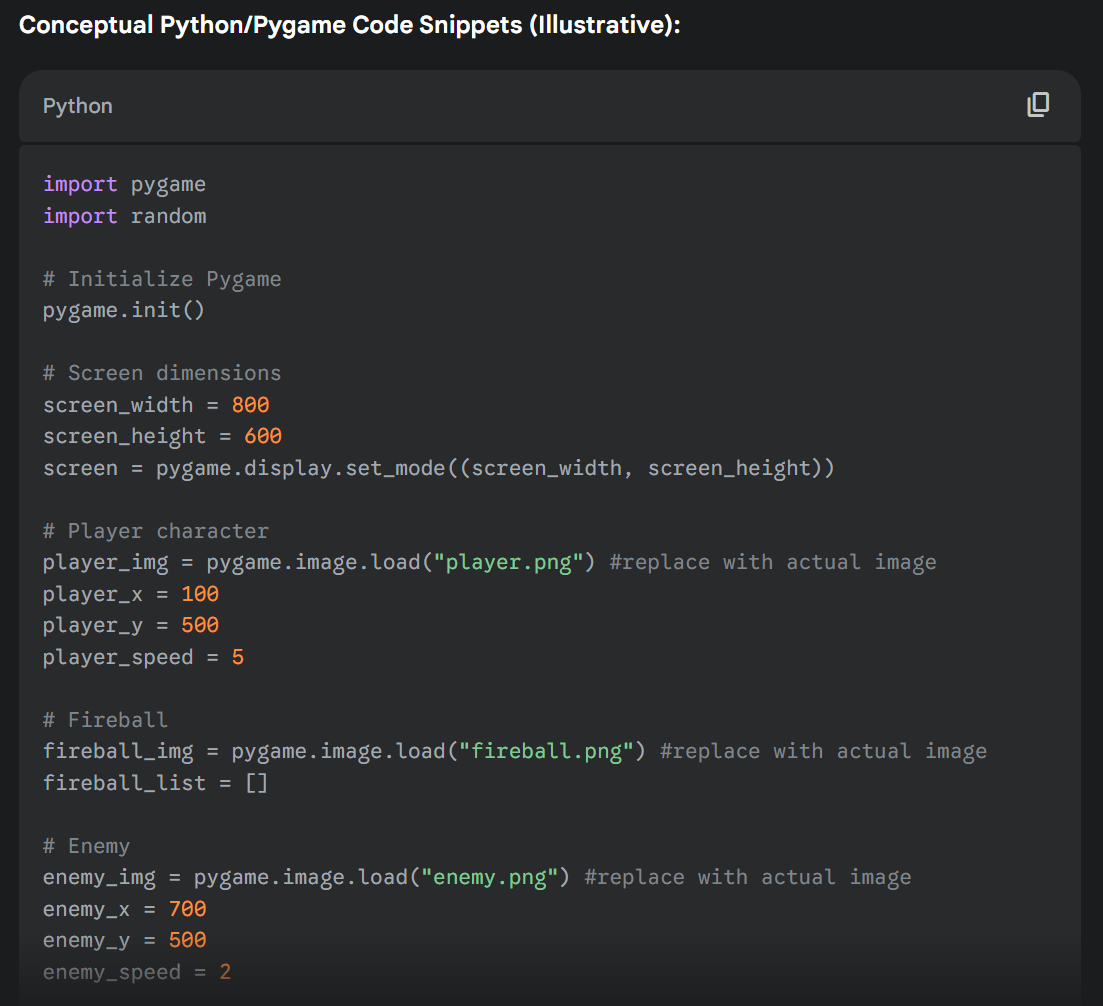
AI-generated code for a video game based on basic prompts on Google Gemini
AI-generated code for a video game based on basic prompts on Google Gemini
“AI has been very effective when used well and carefully.”
“The dark side is that for some companies where greed is the main driving force of what happens, it’s likely that people will expect more out of workers in shorter times to maximise profits."
James Busby
Director, Ten24 Media


“I am 100% against the way current AI systems have been trained.”
Ten24, a gaming support studio with contributions to big AAA titles such as Baldur’s Gate 3, Death Stranding, and Senua’s Saga: Hellblade II, is currently planning to use AI to generate 3D character models based on facial data from users who sign up for their program.
Realistic 3D character models by Ten24
Realistic 3D character models by Ten24
“AI—no matter how you spin it—is generated from artwork created by real artists. Companies have used that artwork without permission and commercialised a product that directly competes with the very artists whose work they have taken.”
Mr Busby explained it through the following scenario:
“I look at it this way: if you take two images from two different artists, mash them together in Photoshop, and then sell that image, it would constitute copyright infringement. How is it different if you do it with five billion images?”
Mr Busby does believe there’s a positive side to AI as well. He adds that AI allows people to iterate ideas quickly, and that would help smaller studios to “create amazing concepts and artwork they might not otherwise have been able to produce”.
“AI has affected many of my friends who are concept artists. I don’t use generative AI in the workplace because I don’t believe in it, and I don’t want to give money to companies that actively engage in data theft.
“However, I must heavily caveat that by saying it’s all made possible by corporations effectively stealing artwork—which, in my opinion, is not a net positive."
Will AI steal jobs?
A big question that looms around AI is employability.
There are growing concerns that AI will eventually replace several job roles in game development ecosystems.
Both Mr Wood and Mr Busby feel that it will not be the case. Mr Busby expanded on his belief by stating that this public opinion stems from the mistrust of AI.
“If there is a misconception, it’s that AI will take our jobs.”
Mr Busby added: "More likely, as with any technological revolution, it will change how we work. If implemented properly, it could create entirely new industries, employing thousands. It could also enable anyone to create projects and games as part of very small teams, competing with the AAA studios we see today.”
Future of AI in gaming
It is difficult at the nascent stages of AI's involvement in game development to accurately predict what the future holds for how gaming will evolve.
However, a look at Nvidia's progress in AI development for video games paints a picture of where game development is headed towards.
Nvidia is currently the most valuable company in the world. This rise to the top spot was not overnight.
Nvidia, a graphics card manufacturer, released its own AI technology to power its GPUs back in 2019 before the worldwide AI boom that we see today.
AI has been powering Nvidia's weaker GPUs to run video games at a level of performance that was not possible before.
NVIDIA ACE
Nvidia is developing its own Generative AI models to change how players interact with NPCs (non-playable characters) in a video game.
Open-world games have hundreds of NPCs, and many of them do not have a single dialogue to offer.
Nvidia ACE project is using Generative AI to create real-time conversations between NPCs in a video game. (Video: Nvidia | YouTube)
Nvidia ACE's AI would ideally be capable of having real-time conversations with players based on the responses it receives from a player.
This is how Nvidia ACE's Generative AI would work:
Player interacts with an NPC in a video game.
The AI would then process various elements to adapt to a player's conversation, including backstory, where the story is presently, AI retaining memory of the player's previous sections, among other factors.
This will enable an NPC to talk to a player in real-time through Gen-AI and have a conversation based on in-game scenarios.



What's beyond Nvidia ACE?
Mr Busby envisions a future of gaming that transcends beyond AI-led NPC conversations, highlighting the scope of AI to create entire game levels from scratch and tailored to a gamer's interest.
“Going forward, I foresee a future where AI is used as a real-time overlay feature. For example, the game could run a basic animatic-style rendering, then overlay real-time AI textures, lighting, and secondary animations.
If done properly, this would allow for highly customisable environments and characters, giving players the ability to tailor the look and feel of the game they’re playing.”
Can AI improve efficiency in game development?
Mr Wood hopes that gaming studios can work towards using AI to improve productivity and reduce costs.
“I hope that AI specialists become a part of larger games companies so that games can be made more efficiently, removing crunch and hopefully making larger games more economical, and give people better work-life balance.”
One thing is clear about AI's role in video games: It will redefine how games are made and look like in the future.
 Built with Shorthand